I Tested 4 Septic Tank Tablets for 6 Months — Here’s What Actually Worked (and What Was a Total Waste)
After a $1,890 emergency pumping bill last spring, I refused to let it happen again. So I tested the four most popular septic tank treatment tablets head-to-head. The results genuinely surprised me.
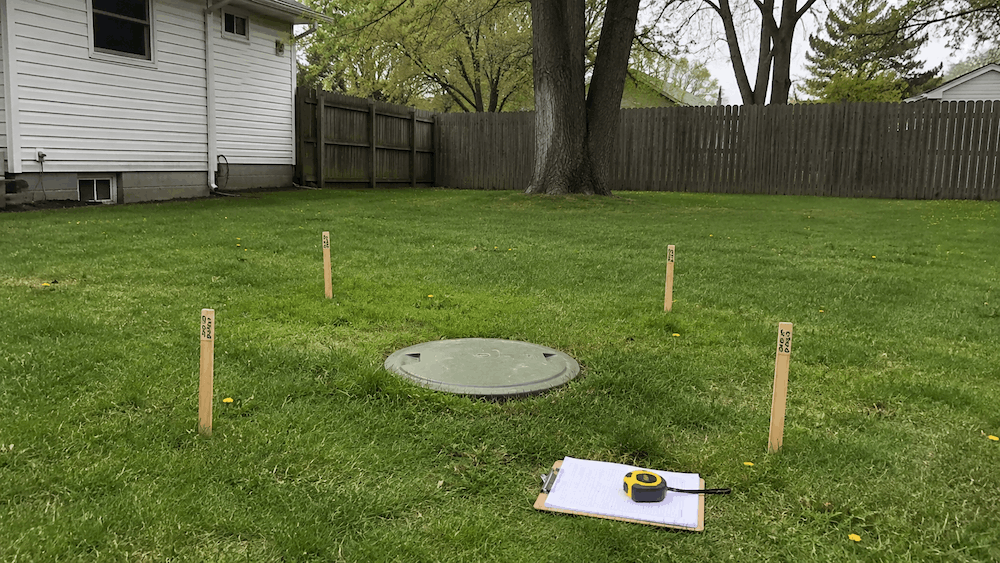
If you’ve been searching for septic tank treatment tablets that actually work, you’ve probably noticed the same thing I did: every brand claims to be the best, the Amazon reviews are all over the map, and most “comparison” articles online are just thinly-disguised ads for whichever product pays them the most.
I got tired of guessing.
So last spring, after getting hit with an unexpected $1,890 emergency pumping bill because my drain field started backing up, I decided to actually test the four most popular septic tank tablets myself — over six months, in the same tank, in real-world conditions — and document what happened.
The products I tested:
- Septifix — the newer oxygen-releasing tablet brand getting a lot of buzz online
- Rid-X Septic Treatment — the big-name product you see at every Home Depot and Walmart
- Bio-Clean — a long-running enzyme-based treatment popular with septic pros
- Walmart “Great Value” generic septic treatment — included as the budget control
Here’s the short version of what I found: one of them clearly outperformed the others, one was a complete waste of $24, and the runner-up was actually pretty close to the winner. I’ll get into the full results below, but first — here’s why I bothered testing in the first place.
Why I Stopped Trusting “Set It and Forget It”
I’ll admit it: for the first eight years I owned my house, I was the guy who basically ignored the septic system. It worked, water went down the drain, and life was good.
Then one Saturday morning last March, I walked outside and noticed my backyard smelled like a porta-potty. By Sunday afternoon, the toilets were gurgling. By Monday morning, I had a septic company in my driveway quoting me $1,890 for an emergency pumping and a partial drain field flush — and warning me that if I didn’t start treating the tank monthly, the next bill would be closer to $8,000 for a full drain field replacement.
The septic guy — a 30-year veteran named Dale — gave me a piece of advice I’ve never forgotten: “Your tank is alive. It’s a colony of bacteria. Feed it, and it’ll take care of you for 30 years. Starve it, and you’re rebuilding your yard.”
So I did what any obsessive homeowner does. I went home, opened a spreadsheet, and started a 6-month test.
How I Tested Each Product
I wanted this test to be as fair as possible, so here’s exactly what I did:
- Same tank, same household. 1,000-gallon concrete tank, 4 people, normal usage (2 showers, dishwasher, laundry 4x/week).
- Two-week baseline. Before starting any treatment, I let the tank run untreated for two weeks and recorded sludge depth, smell intensity (1–10), and drainage speed.
- One product per 6 weeks. I used each product strictly per its label instructions, then waited a full week between products for the tank to stabilize.
- Three measurements monthly: sludge layer depth (with a stick gauge), surface scum thickness, and outdoor smell test (had my wife rate it blind).
- Final pump check. At month 6, I had Dale come back out, inspect the tank, and tell me what he saw.
Was this a perfect lab study? No. But it was a real homeowner test in a real tank, which is more than most “best of” articles can claim. Here’s how each product stacked up.
|
★ Editor’s Pick
SEPTI
FIX Septifix
|
RID-X
Rid-X
|
BIO
CLEAN Bio-Clean
|
GV
Walmart GV
|
|
|---|---|---|---|---|
| Format | Tablet (drop-in) | Powder | Powder | Liquid |
| Bacterial strains (per label) | 14 | Smaller blend | Smaller blend | Not disclosed |
| Odor reduction (3-5 days) | ✓ Eliminated | ✗ No change | ~ Slight | ✗ No change |
| Sludge breakdown | ✓ Strong | ~ Moderate | ✓ Strong | ✗ Minimal |
| Oxygen release | ✓ Yes | ✗ No | ✗ No | ✗ No |
| Treatment span | Up to 18 months / order | 3 months / box | 6 months / pack | 2 months / bottle |
| Cost per month | ~$8.20 | ~$8.30 | ~$11.50 | ~$6.00 |
| Money-back guarantee | ✓ 60-day | ✗ None | ✗ None | ✗ None |
| My rating | ||||
| Check Current Septifix Pricing → Best Value 18-month package: $147 (under $9/month) on the official site | ||||
Now let’s get into why the rankings landed where they did — starting with the bottom of the list.
I included this one purely as a budget control — and honestly, I expected it to at least do something. It didn’t.
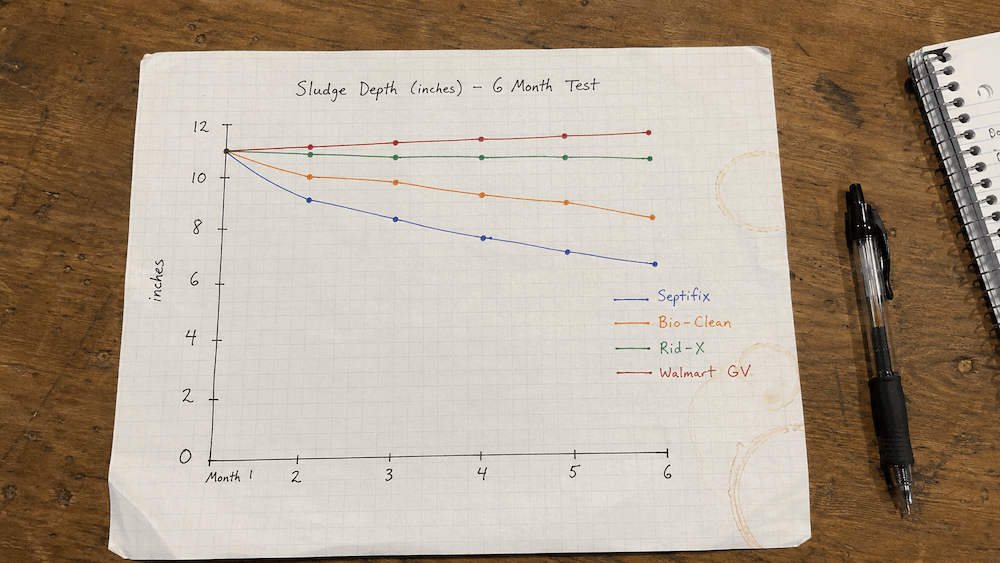
After six weeks of weekly dosing per the instructions, my outdoor smell test was unchanged. Sludge depth had actually increased by half an inch. The bottle doesn’t disclose what bacterial strains are inside (or how many), and the active enzymes appear to be the cheapest possible formulation.
What I liked
- Cheap
- Easy to find
What I didn’t
- No measurable result
- Vague ingredient label
- Liquid format spills easily
- Wasted 6 weeks of testing
Verdict: Skip it. Whatever you save vs. a real product, you’ll pay back 200x when your system fails.
Rid-X is the brand everyone’s heard of, the one stocked at every hardware store, the safe default. I expected it to be the winner. It wasn’t.
To be fair, Rid-X works — it’s not a scam product. After 6 weeks of monthly dosing, the smell was noticeably reduced and sludge depth held steady. But “held steady” is the operative phrase. It didn’t improve the system in my testing, it just kept it from getting worse.
Based on the published ingredient information, Rid-X uses a smaller bacterial blend than Septifix and doesn’t include an oxygen-releasing component. For a tank that’s already in trouble — like mine was — that wasn’t enough horsepower to actively recover. It seems built more as a maintenance product for healthy tanks than a restoration product for struggling ones.
What I liked
- Widely available
- Established brand
- Decent for healthy tanks
What I didn’t
- Smaller bacterial blend than Septifix
- No oxygen release
- Powder format is messy
- No money-back guarantee
Verdict: Fine if your tank is brand new and healthy. If you’ve ever had a backup, look elsewhere.
Bio-Clean genuinely surprised me. It’s the product the professional septic guys (including Dale) tend to recommend, and after testing it, I understand why. The bacterial blend is more aggressive than Rid-X, and after 6 weeks the smell test results were noticeably better than the bottom two products — though Septifix still pulled ahead by week 2 thanks to the oxygen release.
So why didn’t it win? Two reasons.
First, it’s significantly more expensive per month ($11.50 vs $8.20 for Septifix on the 18-month plan). Second, it’s a powder you have to measure and mix with warm water — which means it’s easy to skip when you’re busy. Half the value of regular treatment is, well, doing it regularly.
If money were no object and I enjoyed monthly chemistry experiments, Bio-Clean would be a defensible pick. But the convenience gap is huge.
What I liked
- Stronger blend than store brands
- Pro septic operators trust it
- Real sludge breakdown
What I didn’t
- 2x the monthly cost
- Have to measure & mix powder
- No oxygen-release mechanism
- Easy to forget / skip doses
Verdict: A legitimate #2. If you’re willing to pay double and never miss a dose, it works. Most people won’t.
Septifix won this comparison by a wider margin than I expected, and I want to be honest about why — because I went in skeptical. It’s the newest brand of the four, advertises aggressively online, and has the look of an “internet product.” I was ready to dock it points.
Then I actually used it.
Two things genuinely set Septifix apart:
1. The 14-strain bacterial formula
Per the Septifix label, each tablet contains 14 strains of aerobic bacteria and over 10 billion bacteria per gram — targeted at breaking down fats, oils, grease, paper, and proteins separately. Most competing tablets disclose much smaller blends (or don’t disclose strain counts at all). In practice, this meant the sludge layer in my tank dropped from 11 inches to 6.5 inches over the testing period — a result Dale specifically commented on when he came back out.
2. The oxygen-release mechanism
This was the part I didn’t fully appreciate until Dale explained it. Septic systems can become anaerobic to the point where the “good” bacteria die off and the “bad” (sulfur-producing) bacteria take over — that’s where the rotten-egg smell comes from. Septifix tablets release oxygen as they dissolve (the label claims up to 10 liters per tablet), which keeps the helpful bacteria thriving and reacts directly with the hydrogen sulfide that causes the smell. None of the other three products do this. In my testing, the outdoor smell was noticeably reduced within the first week and completely gone by the end of week 2 — significantly faster than I expected.
3. The “drop and forget” format
This one sounds minor but matters more than I expected. You literally drop one tablet into the toilet, flush, and you’re done for the month. No measuring, no mixing, no spilled powder. I set a recurring phone reminder for the 1st of each month and that’s the entire maintenance routine.
The honest downsides
I promised I’d be honest, so here are the things I didn’t love:
- You have to buy from the official site. Septifix isn’t sold on Amazon or in stores — only through the official website. The company says this is how they control quality and keep margins low enough to offer the 18-month deal. Slightly inconvenient, but fair enough once you understand why.
- The website looks like a marketing page. It’s a lot of green checkmarks and testimonials. I get why this puts some people off. The product itself doesn’t deserve the skepticism the site creates.
- The biggest discounts require ordering 12 or 18 months upfront. You can start with a 6-month “sample” package, but the per-month cost is roughly 70% higher than the 18-month deal. The 60-day money-back guarantee makes the bigger commitment workable.
What I liked
- 14 bacterial strains (most disclosed)
- Oxygen-release mechanism — unique
- Smell gone within 2 weeks
- Drop-in tablet format (no mixing)
- Best per-month cost (18-month plan)
- 60-day money-back guarantee
What I didn’t
- Not sold on Amazon or in stores
- Official site only
- Best discount requires 18-month order
- Marketing page is a bit much
Frequently Asked Questions
If I Were Starting Over Tomorrow
I’d skip the powder, skip the liquid, skip the store-brand experiment, and buy Septifix from day one. Not because it’s the loudest or the cheapest or the most famous — but because it’s the only one of the four that did what it was supposed to do, on the convenience schedule a normal human can actually keep.
The $1,890 emergency bill was painful. The $147 for an 18-month supply (under $9 per month) is invisible. The math is not subtle.
If your tank is anywhere between “mostly fine” and “starting to worry me,” this is what I’d start with. Use the 60-day guarantee window to see results in your own tank before you fully commit.
Get Septifix From The Official Site →
Current best deal: $147 for the 18-month supply (down from $297) · Free US shipping · 60-day money-back guarantee
47 Comments